Pulse / Job Board · SHV (Adaptfy) · 2024
Bringing job postings from many systems into one place

Overview
What is the Job Board?
SHV is a family of companies, each with its own recruitment system and careers site. The Job Board brings their vacancies together on SHV.nl, so anyone, from the public or inside SHV, can find opportunities across the whole group.
I was the product owner, working with HR and recruitment teams, a data engineer, the data platform team and the website team.
How it works
From posting a job to finding it
Companies post jobs as usual
Recruiters keep using their own recruitment system. Nothing changes for them.
Jobs flow into one place
Every hour, a data pipeline collects the vacancies, checks them and turns them into one standard format.
People find and apply
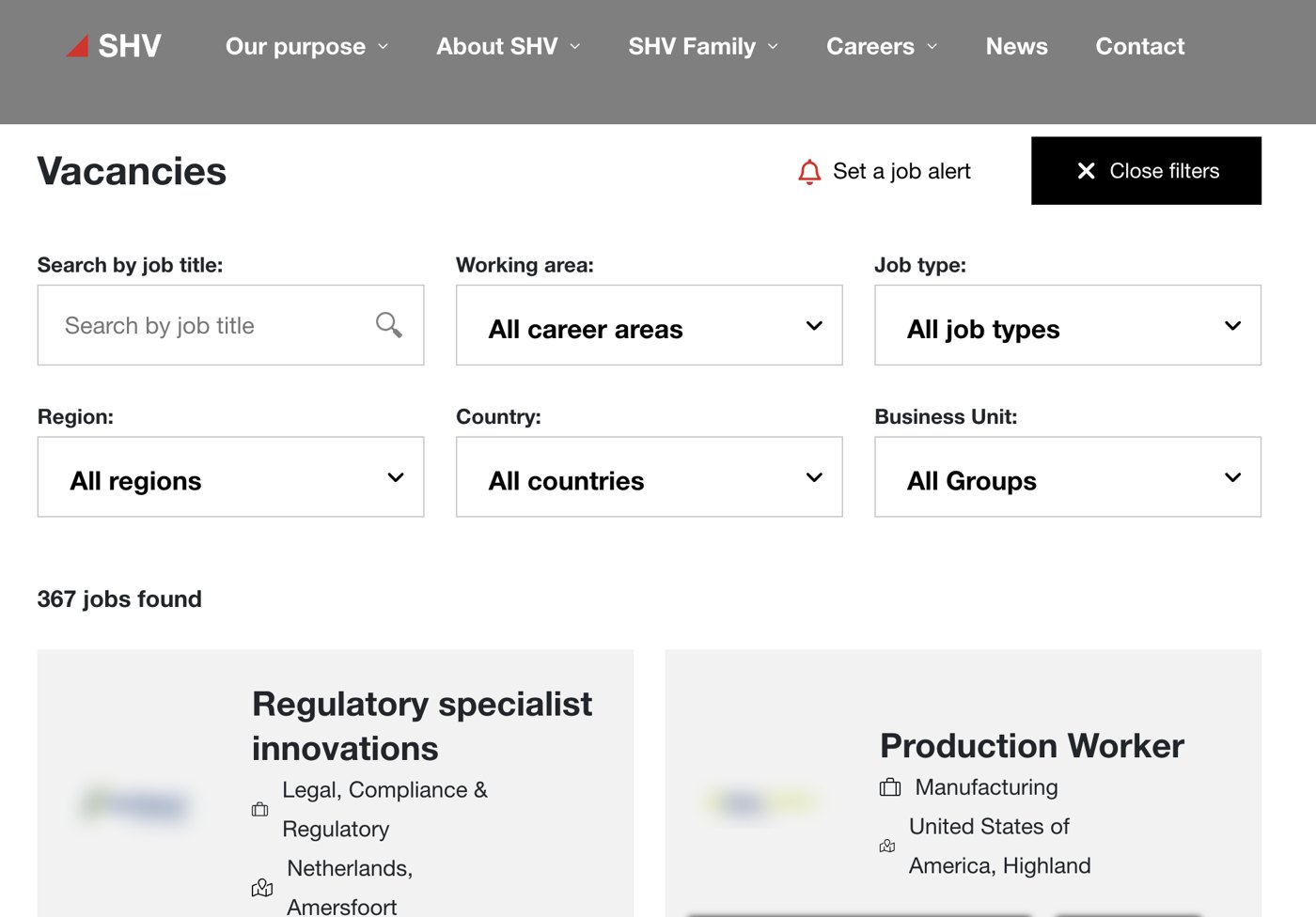
Visitors search and filter jobs by location, job type or company on SHV.nl. Employees log in with a one-time password to see internal jobs too. “Apply” takes them to the job on the company’s own site.
The challenge
Many owners, one format
The hard part wasn’t the technology. Every company owned its own data, used a different system and described jobs in its own way. Nothing could be built until everyone agreed on what a “job” looks like.
Key decisions
Decisions that shaped the product
Agree on a data contract first
For each company, we wrote down the shared format (job title, location, internal and external posting dates, apply links), the allowed values and the rules. For example, an internal job must have an internal apply link. Both sides signed it off before development started.
Keep listings up to date automatically
Data is collected every hour. Jobs that disappear from the source are marked as removed, so the site never shows closed jobs. To check the data, we compared the number of jobs on each company’s site with SHV.nl.
Keep applications where they are
The Job Board only shows and searches jobs; applying happens in each company’s own system. Recruiters didn’t have to change how they work, and the scope stayed small.
Plan for life after launch
Before handover, we agreed who handles what: website issues go to the communications team, data issues go to the platform team and the company that owns the data.
Tech stack
What it’s built with
Reflection
What I learned
1In data integration, agreement is most of the work.
Getting several companies to agree on one format took more time than building the pipeline.
2Writing the rules down saves time later.
The data contract meant fewer surprises and less rework.
3Dependencies set the timeline.
Access credentials and other teams’ availability decided our speed more than our own work did. Raising them early at Steerco helped.
4Launch isn’t the end.
Clear ownership after go-live matters as much as the build.